Start a chat.
 Call us.
 WhatsApp us.
 Create a ticket.
Your website is set up in Google Search Console, you track clicks and impressions, and you have a rough idea of which pages drive traffic. But in the meantime, something else has been happening: more and more businesses and creators are also publishing valuable content on Instagram, YouTube, TikTok, or X. And that's exactly where a gap has existed for a long time. You may have seen reach on the platform itself, but had little insight into how that content was found through Google.
That's now changing. Google has expanded Search Console with what are called platform properties for social media. This lets you view the performance of supported social and video platforms directly within Search Console. For businesses that want visibility beyond their own website, that's a significant step forward.
What's new in Google Search Console?
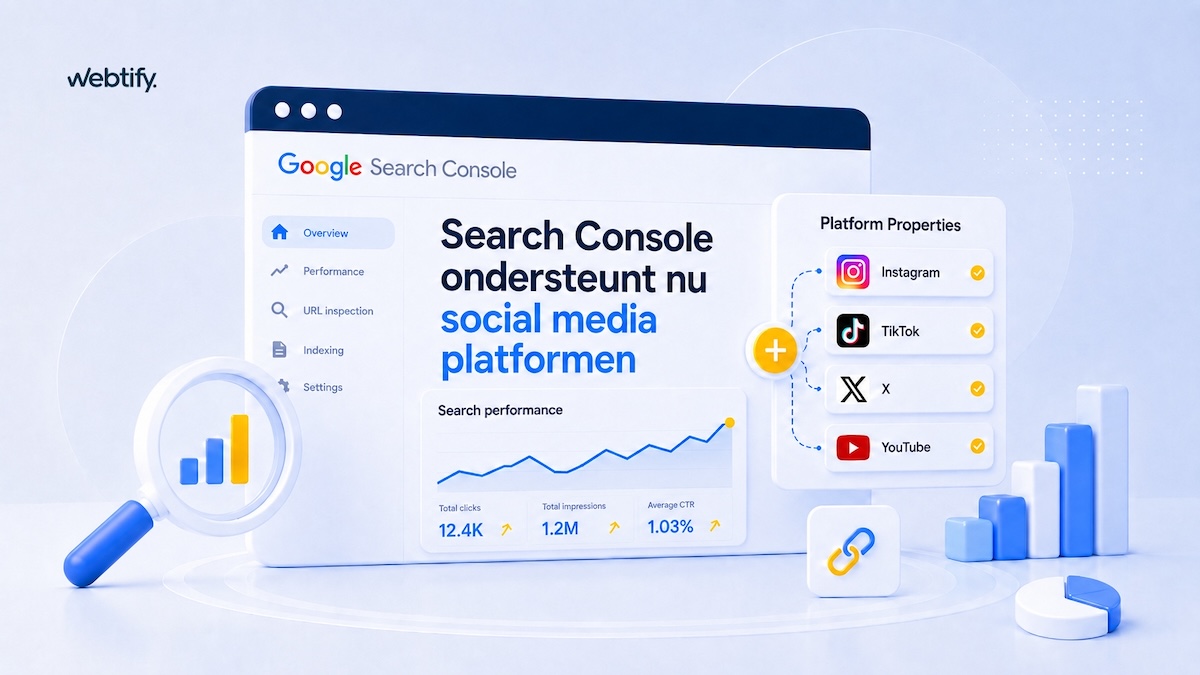
Google has added a new property type within Search Console: platform properties. This means you can now add not just a website property, but also connect an account or channel from a supported platform. Currently, this includes Instagram, TikTok, X, and YouTube.
In practice, this means you can see how people find your content from these platforms through Google Search. If your Instagram post, YouTube video, or TikTok content appears in Google, Search Console can now show insights about that. According to Google, these reports may also include data from Google News and Discover, if your content appears there.
Why Google added this
This step makes sense given how people search today. Not everything starts on a regular webpage anymore. Users increasingly search for videos, short updates, visual explanations, and content from creators or brands on other platforms. Google clearly recognizes that online visibility has become broader than just your own domain.
At Webtify, we see this in practice too. Businesses invest in their website, but also publish on social media alongside it. In that case, it helps to look not only at reach within Instagram or YouTube itself, but also at the question: is this content actually being found through Google?
How does Social media work on Google Search Console?
The basic setup is similar to a regular Search Console property, but for a platform account or channel instead. You add a platform property in Search Console and then select the correct account. Google is rolling out this feature in phases, so you may not see it right away.
Once added, you get access to reports with performance data, including clicks, impressions, and insight into how users discover your content through Google. In its help documentation, Google also describes an insights overview featuring recent trends, top-performing content, and search queries that drive traffic to your platform content.
Which platforms are supported?
At the moment, Google names the following supported platforms:
- TikTok
- X
- YouTube
It's important to add each account or channel as a separate property. So if you have multiple channels or brands, you keep them separate from one another.
So what exactly can you see?
These reports focus on performance in Google, not on all the statistics of the social platform itself. So you're not looking at likes, followers, or watch time within Instagram or YouTube Studio, but at visibility and traffic from Google Search. That's exactly what makes this data valuable alongside your existing social statistics.
Think, for example, of questions like:
- which search terms is my platform content being found for?
- which posts or videos generate impressions or clicks on Google?
- which content performs better in Search or Discover?
- which platform best matches my search behavior and target audience?
What's in it for you as a business owner?
For many businesses, this is especially valuable because it makes your marketing picture more complete. Your website is still often your foundation, but your online visibility no longer plays out there alone. If a video, reel, or post drives traffic through Google, you'll want to be able to measure that too.
It also helps with content decisions. You might discover that short how-to videos are surprisingly easy to find through Google, while regular social updates barely generate any search traffic. Or you might see that branded searches mostly land on your YouTube channel. Then you can steer your efforts more precisely.
It also aligns well with broader SEO developments. At Webtify, we often get asked whether SEO is still just about web pages. The honest answer is: less and less. That's why it's smart to also understand how you rank higher in Google and what role different types of content play in modern search results.
What's the difference from regular website data?
A regular Search Console property shows how your website performs in Google. A platform property shows how content from a connected social or video platform performs in Google. These may look similar, but they are two different data sources within the same environment.
That combination is exactly what makes it interesting. You'll soon be able to better compare what your website delivers with what your external content channels do. If you also use tools like Analytics, it's smart to understand the difference between search data and behavioral data. Our article on what Google Search Console is offers a good foundation for this, as does our explanation of Google Analytics vs Google Tag Manager.
Are there any limitations?
Yes, and it's good to be clear about these from the start. Not every platform is supported, the rollout happens gradually, and you only see data about how content is found through Google. So this isn't a replacement for your social analytics, but an addition to it.
Visibility also doesn't automatically mean success. Lots of impressions look great, but ultimately you want to know whether the content is also contributing to brand awareness, leads, or traffic to your site. That's why the combination with your website and conversion points remains important. It's also why we often refer to topics like website CRO and content structure.
A logical next step in SEO
The addition of Social media to Google Search Console mainly shows how broad search behavior has become. Google no longer looks only at classic web pages, but also at content on platforms where people are active every day. For businesses, that's good news, because it makes your visibility easier to measure.
The key takeaway is simple: stop viewing your social content as separate from SEO. If your Instagram posts, videos, or other platform content can be found through Google, they belong in your analysis too. And that's exactly why this new feature is interesting: you finally get a clearer picture of how all your content performs together in Google.
It means that Google Search Console now supports platform properties. This lets you view performance data for content on supported platforms such as Instagram, TikTok, X, and YouTube, as far as that content is visible through Google Search, News, or Discover.
Google currently lists Instagram, TikTok, X, and YouTube as supported platforms for platform properties in Search Console. Availability may be rolled out in phases.
No. The reports in Search Console focus on performance in Google, such as clicks, impressions, and search queries. Statistics like likes, comments, and followers remain part of the social platform itself.
Because it lets you better measure how content beyond your own website is found through Google. This gives you a more complete picture of your online visibility and helps you make better choices for SEO, content, and channel strategy.
No. A platform property is an addition to your existing website property. You use both side by side to understand how your website and your social or video platform content perform in Google.