Start a chat.
 Call us.
 WhatsApp us.
 Create a ticket.
Your Web site attracts visitors, but inquiries fail to materialize. Or people click around, but don't fill out your contact form. This is exactly the point where many business owners wonder: traffic is coming in, but why is it yielding so little?
At Webtify, we often get that question. And usually it's not just because of SEO or ads, but because of what happens after the click. That's where Website CRO comes in.
What is CRO?
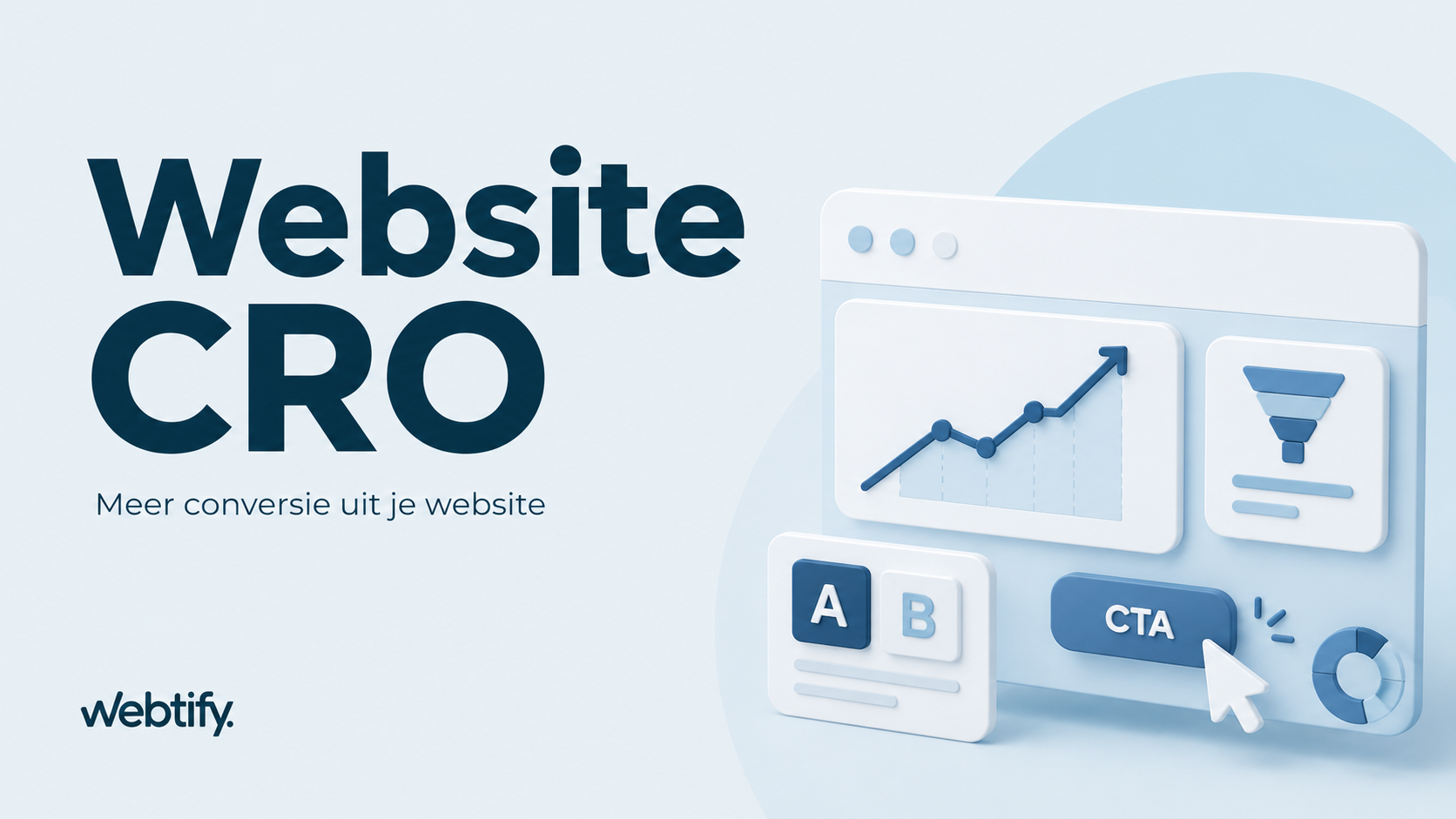
CRO stands for conversion rate optimization, or conversion rate optimization of your Web site. Simply put, you improve your website so that more visitors take the action that is important to your business.
Such a conversion can be anything. Think a completed lead form, a phone call, a quote request, a newsletter subscription or a purchase. According to Google, a conversion rate is the percentage of interactions that lead to a desired action. So CRO is not just about getting more visitors, but more importantly getting more results from your existing traffic.
Why Website CRO matters
Many business owners focus first on findability. Logical, because without visitors, little happens. But if your website is unclear, loads slowly or does not drive action well, you are missing opportunities.
That's why CRO is so important. You don't always need to buy in more traffic if your website can already perform better with the same number of visitors. In practice, that is often faster and smarter than just continuing to invest in extra reach.
If you find that your Web site is not delivering enough, it is also smart to look more broadly at why your Web site is not delivering enough customers. CRO is often an important part of this.
What do you look for in Website CRO?
1. A clear next step
Visitors need to quickly understand what you expect of them. Do you want someone to contact you, request a demo or order a product? Then that step must be clearly visible and logical.
We at Webtify often see websites wanting too much at once. Too many buttons, too many choices and too much information actually create doubt. A good CRO page steers focused on one main action.
2. Confidence and conviction
People only convert when they feel trust. This is not only in design, but also in content. Think clear texts, customer reviews, practical examples, labels and a professional appearance.
Even small things make a difference. A shoddy form, unclear pricing information or outdated content can create just enough doubt to cause people to abandon.
3. Good forms
In lead generation, the form is often the most important part of the page. Yet that's where things often go wrong. Forms are too long, unclear or ask for information that is not needed at that moment.
If the goal is a request, we at Webtify actively manage that. For example, we look at the number of fields, the order, the text on the button and what someone sees after sending. This is precisely where there is often profit.
Do you work with WordPress? Then it may also help to take a critical look at your forms and setup, for example, contact forms in WordPress.
4. Speed and ease of use.
A fast website helps not only for SEO, but also for conversion. Google calls Largest Contentful Paint an important user experience metric and recommends a good score of 2.5 seconds or faster. If a page feels slow, visitors are more likely to drop out.
That's why performance is also part of CRO. A page should load quickly, work well on mobile and feel pleasing to the eye.
5. Measure what works
CRO is not guesswork. You look at data, behavior and results. Which pages draw traffic? Where do people drop out? What form is being opened but not submitted?
With tools like analytics and event tracking, you can see much better where opportunities lie. That's why it's smart to set up your measurements properly as well, such as with the right Google tools for your website.
Website CRO is more than adjusting a button
Sometimes CRO is made small as if it's only about the color of a button. But good Website CRO looks at the big picture: technology, content, structure, trust and ease of use.
A button can certainly make a difference, but only if the rest of the page is also correct. If your offer is unclear or your form doesn't work logically, a different button color isn't going to fix that.
How Webtify handles this
With a website subscription, we pay attention to this by default. Not always with exactly the same focus, because it varies from company to company. A local service provider has different goals than a web shop or knowledge platform.
But if leads are important, we do target them. Then, for example, we look at landing pages, call-to-actions, forms, mobile display and the logic of the route to contact. The goal is simple: make sure your website is not only beautiful, but also really delivers.
From visitors to inquiries
Website CRO means making your website smarter for results. Not by just tweaking things, but by making targeted improvements to what visitors need to take action.
The basics are often straightforward: a clear message, trust, good forms, speed and measuring what works. And that is exactly where many websites miss opportunities. Do you want to pay structural attention to this without constantly being technically busy yourself? Then it is nice if that is simply included.
Frequently asked questions about CRO
CRO means conversion rate optimization. On a Web site, that means improving pages, forms and user experience so that more visitors take a desired action, such as contacting you or making a purchase.
This varies by industry, target audience and type of website. Different figures often apply to a lead website than to a web shop. Therefore, it is smarter to measure your current performance first and improve it step by step.
Not directly as a ranking factor in itself, but indirectly. A clear, fast and user-friendly website helps visitors move on better and often aligns well with what search engines also find important.